
Lithium-ion batteries are widely used in various applications, from smartphones and electric vehicles to renewable energy storage systems, owing to their high energy density, efficiency, and relatively long lifespan. However, like all batteries, they experience aging, degradation, and performance issues over time, affecting their reliability and efficiency.
To mitigate these challenges and extend the lifespan of lithium-ion batteries, ongoing advancements in battery health monitoring have become essential. One of the most promising developments in this field is the use of machine learning (ML) techniques to predict, assess, and optimize the health of lithium-ion batteries. By integrating machine learning algorithms with battery management systems (BMS), it is possible to gain deeper insights into battery behavior and improve the overall performance of battery-operated devices.
This article explores the key machine learning applications for lithium battery health monitoring, focusing on how these advanced algorithms are revolutionizing battery diagnostics, predicting failures, and enhancing battery lifespan.
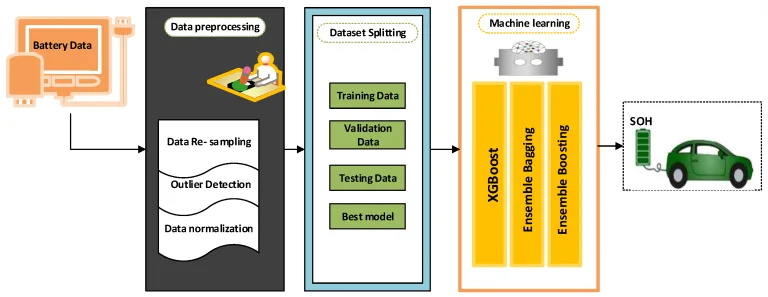
Understanding Battery Health and Its Importance
Battery health refers to the state of a battery’s performance, typically measured in terms of its State of Charge (SOC), State of Health (SOH), State of Function (SOF), and State of Power (SOP). Battery health monitoring involves tracking various parameters, including voltage, temperature, current, and charge/discharge cycles, to detect any deviations from optimal performance and to forecast potential failures. Key indicators of battery health include:
- State of Charge (SOC): Indicates the current energy level of the battery relative to its full capacity.
- State of Health (SOH): Measures the capacity of the battery relative to its original capacity, reflecting its age and degradation.
- State of Power (SOP): Indicates the battery’s ability to supply power at a given moment.
- State of Function (SOF): Evaluates whether the battery is functioning correctly in the system.
Effective battery health monitoring helps in managing and maintaining batteries, preventing failures, enhancing safety, and improving operational efficiency, especially in critical applications like electric vehicles and grid storage systems.
Machine Learning in Battery Health Monitoring
Machine learning involves training algorithms to identify patterns in data, make predictions, and optimize processes. When applied to lithium-ion batteries, machine learning can predict battery behavior, diagnose health issues, and even suggest preventative measures. The main areas in which machine learning contributes to battery health monitoring include:
- Battery Degradation Prediction
One of the most significant challenges in lithium-ion battery management is predicting how and when batteries will degrade over time. Degradation factors like cycling, temperature fluctuations, overcharging, and deep discharges all influence battery life. Machine learning models, particularly supervised learning algorithms, can be trained using historical data from batteries to predict future degradation trends.
- How It Works: Machine learning models, such as regression models and neural networks, analyze the historical data of battery cycles, temperature, voltage, and other variables. By learning the patterns in this data, the models can predict the rate at which the battery will degrade and estimate its remaining lifespan.
- Benefits: This allows users to predict when a battery may need to be replaced or serviced, enabling proactive maintenance and reducing the risk of unexpected failure.
- Anomaly Detection and Fault Diagnosis
Lithium-ion batteries are susceptible to faults caused by overcharging, short circuits, or temperature extremes, all of which can lead to battery failure or even catastrophic events like thermal runaway. Machine learning algorithms can be used to identify unusual patterns in the battery’s behavior and flag potential faults before they escalate.
- How It Works: Unsupervised learning algorithms like clustering and principal component analysis (PCA) can analyze battery data without predefined labels to detect anomalies. These algorithms identify abnormal behavior by comparing real-time performance data to known patterns of healthy battery operation.
- Benefits: Early detection of faults allows users to mitigate risks, such as overheating or fire hazards, by taking corrective action (e.g., charging limitations, cooling strategies) before the battery fails.
- State of Health (SOH) Estimation
Estimating the State of Health (SOH) of a battery is crucial for understanding how much capacity a battery has lost relative to its original capacity. This estimation is vital for managing battery performance, ensuring operational efficiency, and optimizing the charging cycles.
- How It Works: Machine learning algorithms like support vector machines (SVM) and decision trees can be employed to predict the SOH based on input variables like the charge/discharge cycle history, voltage, temperature, and internal resistance. These models can learn to assess the health of a battery even when direct measurement of capacity is not available.
- Benefits: SOH estimation using machine learning enables more accurate predictions of remaining battery life, preventing underperformance and unexpected failures in critical applications such as electric vehicles or grid storage.
- Optimized Charging Strategies
Charging a battery incorrectly—whether through overcharging, undercharging, or charging too quickly—can accelerate degradation and reduce the overall lifespan. Machine learning can play a pivotal role in developing optimized charging strategies tailored to specific battery types and usage patterns.
- How It Works: Machine learning algorithms can analyze historical charging data and learn to predict the most efficient charging profile for a particular battery. Reinforcement learning models, in particular, can continuously optimize charging rates in real-time by learning the best charging practices based on battery performance feedback.
- Benefits: This results in more efficient charging cycles, reducing stress on the battery and thereby increasing its longevity and efficiency.
- Battery Lifetime Prediction and Management
Predicting battery lifespan is essential in applications such as electric vehicles (EVs) and renewable energy storage systems, where battery failures can lead to significant downtime and costs. Machine learning can help estimate the total lifetime of a battery by analyzing various environmental, operational, and usage factors.
- How It Works: Long-term data from battery usage (e.g., charging/discharging patterns, temperature data, and cycling history) is used to train machine learning models to predict the remaining useful life (RUL) of a battery. Algorithms such as long short-term memory (LSTM) networks or Gaussian process regression (GPR) are often employed for this purpose.
- Benefits: With accurate lifetime predictions, users can plan for battery replacement or maintenance well in advance, improving system reliability and minimizing downtime.
- Battery Performance Forecasting in Electric Vehicles (EVs)
In the case of electric vehicles, battery performance is crucial for determining the vehicle’s range, efficiency, and safety. Machine learning can be used to forecast battery performance over time based on real-world driving data, environmental conditions, and driving behavior.
- How It Works: Machine learning models can process data from the vehicle’s BMS, such as charging habits, ambient temperature, speed, and energy usage, to predict how the battery will perform over time. These predictions can also include real-time data to adjust for any changes in battery health or driving conditions.
- Benefits: Accurate forecasting of battery performance helps optimize the range estimation and energy management system in EVs, providing a more efficient and reliable driving experience for users.
Challenges and Future Directions
While machine learning has shown great promise in improving lithium battery health monitoring, there are several challenges:
- Data Quality and Availability: Effective machine learning models require large amounts of high-quality data. In many cases, obtaining sufficient real-world data from batteries, especially in remote or industrial settings, can be a challenge.
- Model Complexity: Developing accurate machine learning models for battery health monitoring involves complex algorithms that require substantial computational resources and expertise to deploy.
- Integration with Battery Management Systems (BMS): For machine learning algorithms to provide actionable insights, they must be seamlessly integrated into the BMS, which requires robust hardware and software infrastructure.
- Real-Time Processing: In many applications, such as EVs and renewable energy storage, real-time performance monitoring and battery management are crucial. Machine learning models need to be optimized for real-time processing, ensuring that predictions and adjustments can be made on the fly.
Conclusion
Machine learning is paving the way for more advanced, accurate, and efficient lithium battery health monitoring systems. From predicting degradation and detecting faults to optimizing charging strategies and forecasting battery lifetime, these technologies are helping extend battery life, improve safety, and enhance performance across a wide range of industries. As data availability improves and machine learning techniques continue to evolve, the future of lithium battery health monitoring looks promising, offering more reliable and sustainable energy solutions.
Related Articles
- Portable Lithium Batteries for Outdoor Adventures: Powering Your Next Expedition
- Lithium Batteries and Safety Concerns: What You Need to Know
- How Lithium-Ion Batteries Are Revolutionizing the Electric Boat Industry
- What are the different types of solar batteries?
- The Future of Lithium Batteries in Aerospace Applications
