
Lithium-ion (Li-ion) batteries have become a crucial power source for modern aerospace applications, ranging from satellites and unmanned aerial vehicles (UAVs) to electric aircraft and space exploration missions. These batteries offer high energy density, long cycle life, and relatively low weight—traits essential for meeting the stringent demands of the aerospace industry. However, as the capacity of these batteries increases, so does the challenge of thermal management. Effective thermal control is critical to maintaining the performance, safety, and longevity of high-capacity lithium-ion batteries, especially in the extreme environmental conditions that are often encountered in aerospace applications.
This guide explores the importance of thermal management for high-capacity lithium-ion batteries in aerospace, examining the challenges, strategies, and technologies that ensure safe and efficient battery operation.
1. The Role of High-Capacity Lithium-Ion Batteries in Aerospace
High-capacity lithium-ion batteries are increasingly powering a wide variety of aerospace applications due to their ability to store large amounts of energy in relatively small volumes. These batteries are used for:
- Electric Aircraft: Advanced electric propulsion systems for small aircraft and the future of electric vertical takeoff and landing (eVTOL) vehicles.
- Space Missions: Satellites, rovers, and deep-space exploration vehicles, where lightweight, high-capacity batteries are necessary for long-duration missions.
- UAVs and Drones: Providing the energy needed for long flight times and reliable performance in remote areas.
- Backup Power Systems: For emergency power supplies in critical aerospace systems.
The growing reliance on lithium-ion technology in aerospace, combined with the need for greater efficiency and capacity, makes thermal management a critical concern.
2. The Thermal Challenges of High-Capacity Li-Ion Batteries
Lithium-ion batteries generate significant heat during charging and discharging, and this effect intensifies as their capacity increases. In aerospace applications, where these batteries may be exposed to extreme temperature variations and rigorous operating conditions, several thermal challenges arise:
2.1. Heat Generation during Operation
- Internal Resistance: As the current flows through the battery, internal resistance generates heat, which can become more pronounced under heavy loads.
- Charge/Discharge Cycles: Repeated charge and discharge cycles can lead to significant heat build-up, especially when batteries are operating near their upper capacity limits.
2.2. External Environmental Factors
- Space Missions: Spacecraft and satellites face extreme temperature fluctuations, from the vacuum of space to the extreme heat of the sun. These temperature differences add complexity to managing battery temperature.
- Atmospheric Conditions: In aviation and UAV applications, altitude changes, pressure drops, and exposure to the elements can influence the battery’s thermal performance.
2.3. Risk of Thermal Runaway
Excessive heat can lead to thermal runaway, a dangerous condition in which a battery’s internal temperature increases uncontrollably, potentially leading to fire or explosion. High-capacity lithium-ion batteries are especially vulnerable to thermal runaway due to the increased energy stored in larger cells.
2.4. Impact on Battery Life
High temperatures, sustained over time, can degrade the battery’s performance, reducing its cycle life and capacity. This issue is critical in aerospace applications, where reliability and long-term performance are non-negotiable.
3. Thermal Management Strategies for Aerospace Batteries
Effective thermal management systems (TMS) are designed to regulate the temperature of high-capacity lithium-ion batteries in aerospace applications, ensuring their safe and optimal operation. Several strategies and technologies are employed to manage heat generation and dissipation:
3.1. Passive Cooling Solutions
Passive cooling systems rely on natural heat dissipation methods and materials to maintain the temperature of lithium-ion batteries. These systems are relatively simple and lightweight, making them ideal for applications where weight is a critical factor.
- Thermal Insulation: High-performance materials like aerogels and phase-change materials (PCMs) are used to insulate batteries and reduce heat absorption. These materials can absorb and release heat, stabilizing the battery’s temperature.
- Heat Sinks: Metallic heat sinks or thermally conductive plates are used to increase the surface area for heat dissipation, helping to spread the heat away from the battery cells.
While effective, passive systems can be limited by the thermal load. In high-capacity applications, additional active systems may be required.
3.2. Active Cooling Systems
Active thermal management systems use mechanical components like fans, pumps, and coolants to actively remove heat from the battery. These systems are more complex but provide higher levels of control over the battery’s temperature.
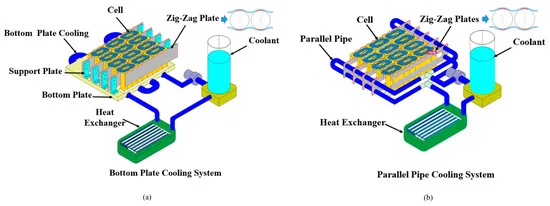
- Liquid Cooling: Involves circulating a coolant (such as water or a special heat transfer fluid) through channels or plates attached to the battery cells. This method allows for efficient heat transfer and precise temperature regulation.
- Air Cooling: Employing fans or blowers to move cool air across the battery cells or within battery packs. This method is often used in applications where liquid cooling may be impractical.
- Microchannel Cooling: A more advanced version of liquid cooling, where fluids flow through very narrow channels integrated into the battery pack. This method is highly effective but requires precise engineering.
Active cooling is often used in aerospace applications requiring high power output and consistent temperature control, such as electric aircraft and space systems.
3.3. Thermal Control Materials
Advanced materials that improve heat distribution and thermal stability are being incorporated into battery designs to enhance overall thermal management:
- Graphite: This highly conductive material can be integrated into battery packs to help spread heat evenly across the cells.
- Thermally Conductive Polymers: Lightweight polymers with high thermal conductivity can be used in battery casings to prevent localized overheating.
- Thermal Management Films: Thin, flexible films can be applied to batteries to provide additional heat dissipation capabilities while keeping the overall weight low.
3.4. Thermal Runaway Mitigation
Preventing and managing thermal runaway is a key priority for high-capacity batteries used in aerospace applications:
- Battery Protection Circuits (BPCs): These circuits are used to monitor the battery’s temperature, voltage, and current. If any of these parameters exceed safe limits, the BPC will disconnect the battery from the load or initiate cooling procedures to prevent overheating.
- Safety Venting: In the event of an internal failure, safety vents in the battery’s casing can release gases and pressure before thermal runaway can occur, reducing the risk of an explosion.
- Fire-Resistant Materials: Battery enclosures made from fire-resistant and flame-retardant materials can help contain the heat in case of a thermal event, protecting other components in the system.
3.5. Temperature Monitoring and Control Systems
Continuous monitoring of the battery’s temperature is vital to ensure that it stays within safe operational limits. Temperature sensors placed throughout the battery pack can provide real-time data on temperature distribution and trigger cooling systems or power limitations as needed.
- Thermal Imaging: In some cases, thermal cameras or infrared sensors are employed to visualize heat generation within the battery pack, allowing engineers to identify hot spots and adjust thermal management strategies accordingly.
- Battery Management System (BMS): The BMS integrates the thermal management system, enabling it to adjust battery charge/discharge cycles based on the temperature readings and provide feedback to the system on when to activate cooling mechanisms.
4. Conclusion
As the demand for high-capacity lithium-ion batteries in aerospace applications continues to grow, the need for effective thermal management strategies has never been more critical. Aerospace manufacturers and engineers must leverage a combination of passive and active cooling systems, advanced materials, and thermal monitoring technologies to ensure the performance, safety, and longevity of these batteries.
Thermal management is not just about preventing battery overheating; it’s about ensuring that high-capacity lithium-ion batteries can operate reliably in the extreme conditions of aerospace environments, whether it’s the vacuum of space, the high altitudes of electric aircraft, or the variable temperatures encountered by drones and UAVs.
By employing cutting-edge thermal control strategies, the aerospace industry can unlock the full potential of lithium-ion batteries, enabling more efficient, safer, and longer-lasting energy solutions for a wide range of aerospace applications.
Related Articles
- The Advantages of Lithium Battery Use for Caravan
- What distinguishes PWM charge controllers from MPPT charge controllers?
- High-Throughput Screening of Solid Polymer Electrolytes: Advancements and Applications
- How Lithium-Ion Batteries Are Revolutionizing the Electric Boat Industry
- How much you paid per kWh of a home solar battery?
