
The growing demand for electric vehicles (EVs) has placed immense focus on battery technology, particularly the materials used for cathodes. Two of the most commonly used cathode materials in modern EV batteries are Nickel Manganese Cobalt (NMC) and Lithium Iron Phosphate (LFP). Both materials have their unique strengths and weaknesses, making them suited for different types of electric vehicles. Understanding the differences between NMC and LFP is crucial for determining the most suitable choice for specific EV applications, considering factors such as cost, energy density, safety, and overall performance.
In this article, we will explore a comparative study between NMC and LFP cathode materials, focusing on their characteristics, advantages, challenges, and performance in electric vehicle applications.
Understanding NMC and LFP Cathode Materials
Nickel Manganese Cobalt (NMC) Cathodes
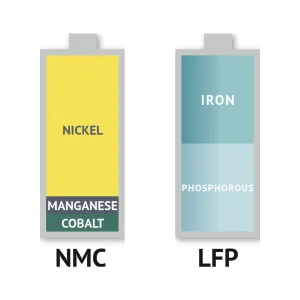
NMC is a popular cathode material used in lithium-ion batteries for electric vehicles, offering a balanced combination of performance, energy density, and stability. It is composed of three key elements: nickel, manganese, and cobalt, each playing a distinct role in enhancing the battery’s performance:
- Nickel provides high energy density, which results in longer driving ranges for electric vehicles.
- Manganese contributes to structural stability and ensures that the battery is durable and resistant to degradation.
- Cobalt improves the overall stability of the battery, but it is expensive and raises ethical concerns related to mining practices.
NMC cathodes are often used in high-performance EVs, where longer range and higher power output are essential.
Lithium Iron Phosphate (LFP) Cathodes
LFP is a more cost-effective and inherently safer cathode material compared to NMC. It uses iron and phosphate as its key components, with lithium as the charge carrier. Although LFP batteries generally have a lower energy density compared to NMC, they offer advantages in terms of safety, cost, and cycle life:
- Iron provides cost-effectiveness and excellent thermal stability, contributing to LFP’s inherent safety.
- Phosphate provides high structural stability, resulting in long-lasting and durable batteries.
- Lithium serves as the main element for energy storage, offering good performance and efficiency.
LFP batteries are commonly used in applications where cost-effectiveness, safety, and longevity are prioritized over energy density, such as in budget EVs, buses, and stationary energy storage systems.
Key Performance Metrics: NMC vs. LFP
- Energy Density
One of the most important factors when considering a cathode material for EV applications is energy density. This metric directly impacts the driving range of electric vehicles.
- NMC: NMC batteries typically offer higher energy densities due to the presence of nickel. This translates to longer driving ranges, which is a key factor for consumer acceptance of electric vehicles. NMC batteries can achieve energy densities in the range of 150 to 250 Wh/kg, making them ideal for passenger electric cars and vehicles that require extended range capabilities.
- LFP: LFP batteries, while safer and cheaper, have a lower energy density. Their energy density usually falls within the range of 90 to 160 Wh/kg. This makes LFP batteries suitable for applications where range is less critical, such as in urban or short-range EVs and commercial vehicles like buses.
Winner: NMC, for higher energy density and longer driving range.
- Cost
The cost of battery materials is a significant factor for both manufacturers and consumers, and it directly influences the overall cost of an electric vehicle.
- NMC: NMC batteries are generally more expensive due to the high cost of raw materials like nickel and cobalt, both of which are limited in supply and subject to price volatility. While advancements in battery chemistry are reducing these costs, NMC-based batteries still tend to be pricier, especially for high-end EV models.
- LFP: LFP batteries are significantly cheaper than NMC due to the abundance and low cost of raw materials like iron and phosphate. As a result, LFP batteries are an attractive choice for more cost-sensitive EV applications, such as economy electric vehicles and mass-market transport.
Winner: LFP, due to lower raw material costs.
- Safety
Safety is a critical concern for lithium-ion batteries, especially for EVs, where thermal runaway can lead to catastrophic failures.
- NMC: NMC batteries, due to their high energy density, are more prone to overheating, especially in the case of overcharging, short circuits, or physical damage. The use of cobalt in NMC batteries can also contribute to issues with stability at high temperatures. However, modern NMC batteries are equipped with various safety features like thermal management systems to mitigate these risks.
- LFP: One of the standout features of LFP batteries is their inherent safety. They have a stable crystal structure, which makes them less likely to overheat and less prone to thermal runaway compared to NMC. LFP batteries can tolerate higher temperatures and are less likely to catch fire, even when damaged or improperly charged.
Winner: LFP, due to superior thermal stability and safety.
- Cycle Life
The cycle life of a battery refers to the number of charge and discharge cycles it can endure before its capacity significantly degrades.
- NMC: NMC batteries generally have a cycle life of 1000 to 1500 cycles, depending on factors such as usage patterns, temperature, and charging habits. While this is adequate for many applications, NMC batteries degrade faster under extreme conditions.
- LFP: LFP batteries excel in terms of cycle life, often exceeding 2000 to 3000 cycles. This long lifespan makes LFP batteries ideal for applications where durability and longevity are crucial, such as buses, trucks, and stationary storage systems.
Winner: LFP, due to a longer cycle life and better overall longevity.
- Environmental Impact and Sustainability
Sustainability is becoming an increasingly important factor in the battery industry, and the environmental impact of battery materials is a key concern.
- NMC: The extraction of nickel and cobalt is associated with environmental damage, including habitat destruction, pollution, and high energy consumption. Furthermore, cobalt mining has been linked to human rights violations and poor working conditions, raising ethical concerns around its use.
- LFP: LFP materials are more sustainable and have a much lower environmental impact. Iron and phosphate are more abundant and environmentally friendly, and their extraction processes have a smaller carbon footprint compared to nickel and cobalt. Additionally, LFP batteries are considered to be more recyclable than NMC, making them a more eco-friendly option for the future.
Winner: LFP, due to its lower environmental impact and more sustainable sourcing.
Applications in Electric Vehicles
NMC in EVs: High-Performance Models
NMC batteries are ideal for high-performance electric vehicles (EVs) that require long-range capabilities, fast charging, and higher power output. Their high energy density makes them a preferred choice for luxury EVs, high-end sports cars, and long-range electric SUVs. The Tesla Model 3, for instance, uses NMC cathodes for its superior energy density and range.
LFP in EVs: Budget and Commercial Models
LFP batteries are becoming increasingly popular for budget electric vehicles and commercial applications like electric buses and delivery vehicles. Their lower cost and higher cycle life make them suitable for mass-market applications, where initial cost is a key consideration. Chinese automakers like BYD have adopted LFP batteries extensively in their EV models, offering an affordable and practical solution for urban transportation.
Conclusion
Both NMC and LFP cathode materials offer unique advantages, making them suitable for different EV applications. NMC is the go-to choice for high-performance electric vehicles that require long driving ranges and quick charging, while LFP offers a more cost-effective, safer, and longer-lasting alternative, ideal for budget and commercial EVs. As EV technology evolves, both materials will likely coexist, with the choice between them depending on the specific requirements of the vehicle and the target market.
Ultimately, the future of electric vehicle batteries will likely involve continued innovation and refinement of both NMC and LFP materials, with ongoing efforts to balance performance, cost, safety, and sustainability.
Related Articles
- Lithium Batteries and Safety Concerns: What You Need to Know
- How to choose between LIFEPO4 and lithium-ion batteries depending on your needs
- A supplier insight for portable power station
- Are Lithium Batteries the Best Choice for caravans?
- Impact of Fast Charging on Degradation of Lithium-Ion Batteries in EVs
