電子メール: [email protected]

サービスホットライン: +86-18022178932

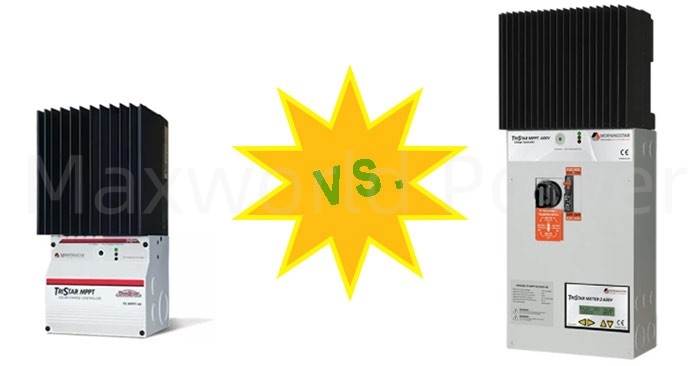
PWM 充電コントローラーと MPPT 充電コントローラーの違い?

The controller controls how much power comes from the solar panel to charge the battery in two separate ways.

最大電力点の追跡, or MPPT

パルス幅変調, or PWM

With MPPT charge controllers, maximum power production is guaranteed even in the face of variable circumstances like as panel degradation, 温度変動, and shadowing. They do this by continuously monitoring the maximum power point of the solar panel array. By quickly switching the connection between the solar panel and the battery bank, the PWM controller controls the charging current while keeping the battery voltage constant.

Compared to MPPT charge controllers, PWM charge controllers are less efficient due to their older technology and lower cost.Both are extensively utilized and serve comparable purposes in prolonging the lifespan of your batteries. It’s also crucial to remember that the finest option is frequently the one that works best for your particular situation rather than the best option overall. さらに, since charge controllers make up a very small percentage of the overall system cost, we strongly advise buying a high-quality controller. The lifespan of charge controllers with pulse width modulation and maximum power point tracking is approximately 15 年, though it may differ depending on the particular controller.

PWM Charge Controllers: 意味

The first charge controller to be utilized was the pulse width modulation controller, which is less complex and costly than MPPT controllers. PWM controllers, often known aspulse width modulation” デバイス, control the energy flowing to the battery by progressively decreasing the current. PWM charge controllers keep the batteries fully charged by providing a very little quantity of power once they are full. Small-scale applications are best served by PWM controllers since the batteries and solar panel system must have voltages that match. Larger installations make this much more challenging.

PWM charge controller advantages

Not as expensive as MPPT controllers

Ideal for more compact setups where efficiency is not as important

Generally longer lifespan since fewer parts are susceptible to failure

Performs best in warm, sunny conditions and when the battery is almost fully charged.

Drawbacks of PWM usage Supervisors

Cons of Charge Controllers with PWM

Not as Effective as MPPT Controllers

Larger, more complicated systems are not the best uses for solar panels since they require batteries and panels to have voltages that match these controllers.

Ideal for: People in warmer climates and those with smaller systems (バン, RV, tiny residences)

What are Charge Controllers with MPPT?

Peak Power Outage Tracking controllers are effective in charging your batteries by utilizing all of the power from your solar panels. To prevent batteries from being overcharged, they set a restriction on their power. To control the current in your solar system, MPPT controllers will monitor and modify their input. MPPT controllers increase current while reducing voltage. This will lead to an increase in overall productivity and efficiency ratings of 90% 以上. 最近, MPPT charge controllers are more widely used.

例えば, your MPPT charge controller will reduce the current drawn if it starts to cloud over in order to keep the desired voltage at the panel’s output. The MPPT controller will permit the solar panel to draw greater current when the sun returns.

MPPT charge controller advantages

Extremely productive

Ideal for larger systems where the extra energy output is beneficial

Perfect in circumstances where the voltage of the solar array exceeds the voltage of the battery

Ideal in cloudier, colder climates

operates at its peak when the battery is barely charged

Cons of Charge Controllers with MPPT

More costly than controllers with MPPT

Usually shorter lifespan because there are more parts

Ideal for: Those who live in colder climates and have larger systems (homes, cottages, 等)

What distinguishes a PWM charge controller from an MPPT charge controller?

The following are the primary distinctions between a PWM and MPPT solar charge controller:

効果

PWM controllers are less effective than MPPT controllers, especially when the weather is unpredictable. By ensuring that the solar panels run at their highest possible capacity, they increase the amount of energy that is captured and stored.

Cost and Complexity

PWM controllers are appropriate for small-scale and cost-conscious applications since they are less complicated and expensive. 一方で, MPPT controllers, which are perfect for larger or more demanding systems, justify their higher cost with enhanced performance and energy efficiency.

Performance under Various Situations

In low light and frigid temperatures, MPPT controllers function better than PWM controllers. They are more adept at adapting to changing environmental circumstances than PWM controllers, which are often less adaptable.

Appropriateness of Use

For modest, straightforward solar setups, including basic home systems or tiny off-grid applications, PWM controllers are frequently adequate. Larger systems, including as complex off-grid systems and commercial installations, are better suited for MPPT controllers because of their increased efficiency and versatility.

PWM 充電コントローラーと MPPT 充電コントローラーの違い?

Mppt vs. PWM charge controller sizing guidelines

すべてを考慮して, charge controller sizing is not as hard as you may imagine. The voltage of the solar system and the current of your solar array determine the size and rating of charge controllers.

一般的に言えば, you want to make sure your charge controller can manage the power and current your panels are producing.

Charge controllers often have voltages of 12, 24, そして 48 ボルト. Ratings for voltage and amperage range from six to sixty volts and one to sixty amps, それぞれ.

You would require a solar charge controller with at least 14 amps if the voltages and amps of your solar system were 12 そして 14, それぞれ. しかし, you need to account for an extra 25% so that our solar charger controller has the minimum amount of amps required, それは 17.5 アンプ, because of things like light reflection, which can occasionally result in elevated current levels. この場合, we’ll round up, so ultimately, ある 12 ボルト, 20 amp solar charge controller would be required.

You also need to consider whether you’re utilizing an MPPT or PWM controller when it comes to charge controller sizing. まで 50% of the power generated by the sun can be lost due to a poorly chosen charge controller.

Things to think about while using MPPT charge controllers: You can create an array as big as you like, but the controller will limit the output since MPPT controllers limit its output. しかし, since you have panels that aren’t being used to their full potential, this indicates that your system isn’t as efficient as it may be. あ 40 Amp MPPT Controller, 例えば, will have an amp reading for it. An MPPT charge controller will always only provide 40A of current, even if your panels are capable of producing 80A.

Something to keep in mind when using PWM charge controllers: PWM controllers cannot set a maximum for their output current. All they do is utilize the array current. その結果, the charge controller you’re using may be harmed if the solar array can generate 40A of current but it is only rated for 30A. Making ensuring your charge controller fits, works with, and is the right size for your panels is essential.

What is the maximum voltage allowed?

Every solar charge controller has a maximum voltage that it can handle. This is the highest voltage that the controllers can manage without risk. Ensure that you are aware of your controllersmaximum voltage limit. そうでない場合, you run the danger of damaging your solar charge controller or posing other safety hazards.

Selecting the Appropriate Solar Charge Controller

When purchasing a charge controller, the following aspects need to be taken into account:

Your spending plan

Duration of the technology

the environment in which your system will be installed

The quantity of solar panels you own and the extent of your energy requirements

Depending on the size, 量, and kind of batteries your system is using, pick the appropriate charge controller.

Typical Charge Controller Errors and Mistakes

Owing to the multitude of components involved in solar installations, errors in installation can occur easily. Here are some typical errors people make using solar charge controllers.

The charge controller should not be connected to AC loads. The output of the charge controller should only have DC loads connected to it.

Some low-voltage equipment need to be wired straight to the battery.

Since accurate voltage monitoring of the battery is a crucial component of a solar charge controller’s operation, the charge controller should always be installed in close proximity to the battery.

Control Points in Relation to Battery Type

The battery’s architecture affects the optimal set points for charge regulation. The great majority of renewable energy systems employed deep-cycle lead-acid batteries, either sealed or flooded, until the mid-2010s. Liquid fills flood-filled batteries. These are regular deep cycle batteries that are reasonably priced.

Saturated pads are used in sealed batteries to separate the plates. They are also referred to as “吸収されたガラスマット,” “バルブ制御式,” or justmaintenance-free.They will dry out and be destroyed if the voltage is not adjusted to a little lower level than that of flooded batteries. Certain controllers allow you to choose the kind of battery. Never use a controller designed for a different kind of battery.

Standard set points at 77°F (25℃) for 12-volt lead-acid batteries

(These are not exceptional; they are merely given as examples.)

Peak voltage (flooded battery): 14.4 ボルト

Top limit (14.0V) for a sealed battery

Resuming the full 13.0V charge

10.8V low voltage disconnect

Connect again: 12.5V

Temperature adjustment for a 12-volt battery:

The standard deviation from 25°C is -.03V per °C.

要約すれば

Solar charge controllers with PWM and MPPT offer pros and downsides of their own.MPPT controllers are appropriate for larger solar systems because they have higher efficiency, quicker charging periods, and greater energy harvesting. For smaller systems, PWM controllers offer an affordable and dependable alternative. You can choose wisely if you are aware of the variations and assess your system requirements.

返信を残す

あなたのメールアドレスは公開されません. 必須フィールドはマークされています *